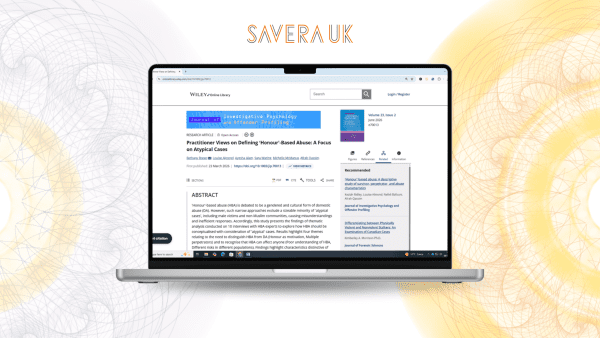
A research paper co-authored by MWOTY 2012 and 2022 alumni and Savera UK CEO and founder, Afrah Qassim, has highlighted a lack of understanding of HBA that is negatively impacting the identification and prosecution of atypical cases and creating barriers to survivors accessing support.
The thematic analysis Practitioner Views on Defining ‘Honour’-Based Abuse: A Focus on Atypical Cases, published in the Journal of Investigative Psychology and Offender Profiling[1], presents the findings of interviews conducted with 10 HBA experts on how it should be defined when considering atypical cases.
While evidence shows that HBA can be found in all communities, most literature focuses on HBA in stereotypical demographics and media narratives of “fanaticism in other faiths” feeds into this cultural framing of the issue. This paper argues that this limits the understanding among both public and frontline professionals of cases of HBA in atypical communities, which practitioners interviewed identified as Jewish, Chinese, Travelling communities, white British, Christian, American and African.
The paper also highlighted that viewing HBA as a form of violence against women and girls (VAWG) was diverting attention from a sizeable minority of men and boys affected by HBA and forced marriage. All participants in the study mentioned the occurrence of men and boys as victims, with unapproved career choices and being LGBTQ+ referenced as key triggers for perpetration. This gendered lens also caused instances of female perpetration to be overlooked or attributed to coercion from male counterparts.
Analysis revealed two overarching themes. The first was ‘honour’ as motivation and multiple perpetrators, which formed the need to distinguish HBA from domestic abuse (DA). The second was poor understanding of HBA, different risks being present in different populations and that HBA can affect anyone, which formed the argument for a better understanding of HBA to improve practice.
The paper highlights how, although HBA may be overrepresented in certain cultures or amongst certain demographics (e.g. male-on-female perpetration), it is not exclusive and until atypical cases are properly explored, understanding of this phenomenon cannot be claimed.
Exploring poor understanding of HBA among professionals, the paper flags the issue of ‘race anxiety’, where the fear of being culturally insensitive or being considered racist prevents professionals from taking appropriate action, leaving individuals at risk – an outcome of viewing HBA through a cultural lens. Similarly, focusing too much on gender can also cause ‘tunnel vision’ whereby male survivors and female perpetrators are dismissed based on stereotypes.
The study acknowledged that while HBA can happen to anyone, stereotypical cases may involve more serious risks than atypical cases. However, in white communities’ ‘honour’ may be attributed to a much wider range of beliefs. Taking the over-simplified view that HBA is abuse perpetrated against an individual due to them behaving against ‘norms’ and expectations, participants in the study also drew parallels between non-familial gang violence and HBA, with similarities drawn in relation to the presence of shared views ‘honour’ and status within a given community (e.g. the gang).
Lead author, Beth Roper, former researcher at University of Liverpool, now Forensic Psychology doctoral researcher at the University of the West of Scotland said: “Our findings highlight a significant gap in understanding HBA, which continues to impact identification and response. By focusing on atypical cases, this research demonstrates that HBA is not limited to specific demographics and can affect anybody. A broader, more inclusive understanding of HBA across policy, practice, and public contexts is needed to ensure all survivors can access appropriate support.”
Professor Louise Almond, University of Liverpool, said: “Conducting this research has broadened my understanding of the diverse ways in which HBA can present, regardless of age, gender, ethnicity, or culture. The study’s findings highlight a clear gap in understanding, which negatively impacts identification, reporting, and organisational responses.”
Afrah Qassim, CEO and Founder, Savera UK, said: “The findings of this study clearly indicate a lack of understanding that negatively impacts identification, reporting and response. More research into and acknowledgement of atypical HBA cases is vital as better understanding of these will break existing stereotypes and reduce barriers to survivors from such populations coming forward for help. As an organisation we have long campaigned for HBA to be seen as an issue that can affect anyone, regardless of age, culture, ethnicity, disability, sexuality, or gender and we want to drive change that allows people at risk and survivors from any background to access the help that they need.”
Read the full paper here: https://onlinelibrary.wiley.com/doi/epdf/10.1002/jip.70013